

Broadway Bank reports record revenue, rules out sale or merger
Click here to access the original article published by the San Antonio Business Journal.
Story Highlights
- Broadway Bank expects 2025 to be the highest revenue year ever.
- The Cheever family-owned bank is not for sale, CEO confirms.
- Broadway Bank holds $5.6 billion in total assets currently.
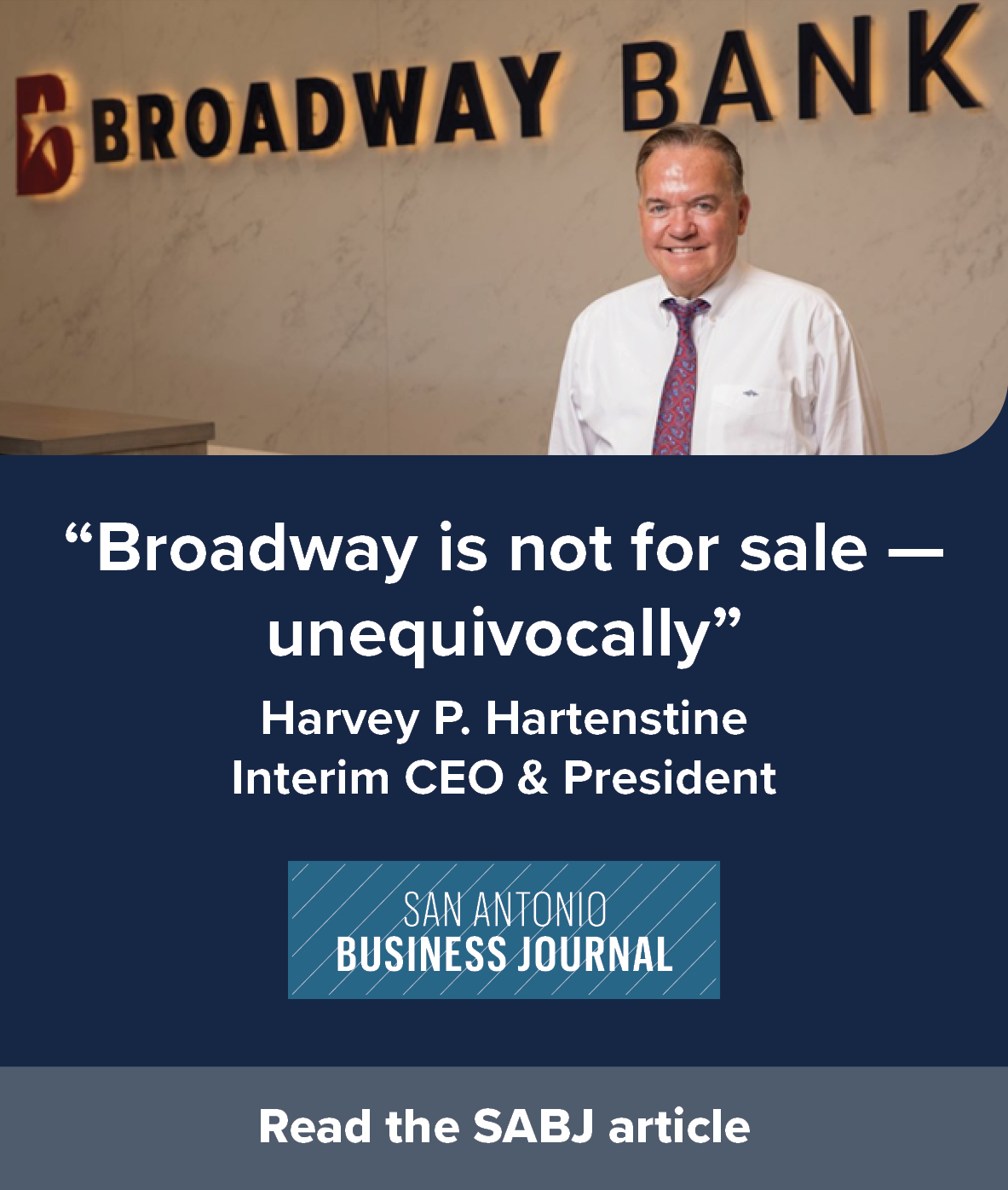
Broadway Bank interim CEO and president Harvey Hartenstine said 2025 will
deliver the highest revenue in the bank’s 84-year history.
With this banner year in the works, Hartenstine, a 45-year banking veteran, also
addressed whether the privately-owned bank has plans to sell or merge.
“Broadway is not for sale — unequivocally,” Hartenstine, who began his career as a
teller and has spent 34 years at Broadway, said. “Our shareholders are committed
to preserving the integrity of their investment and are not interested in any action
that would dilute their ownership.”
The Cheever family, which founded the bank in 1941, controls approximately 90%
of the institution. Fourth- and fifth-generation family members are active in the
company, Hartenstine said.
“We have a lot of people that knock on our door… ‘Now’s the time to sell.’ But the
bank wants to continue to be that strong, family-owned organization,” he said.
As of Q3 2025, Broadway reported:
- $5.6 billion in total assets
- $5.3 billion in deposits
- $3.5 billion in loans
- $3.7 billion in assets under management in its wealth division
Broadway Bank still leads San Antonio’s privately owned banks by a wide margin,
but FDIC data through June 30 show its peers are growing as well:
- Vantage Bank Texas with $4.72 billion in assets
- Jefferson Bank with $2.80 billion in assets
- Texas Partners Bank with $2.35 billion in assets
Broadway's top priorities for 2026 include driving the efficiency ratio to 55% or
lower, down from the low 60s today, while maintaining strong capital and
liquidity positions and generating sustainable earnings, Hartenstine said.
The efficiency ratio measures how much a bank spends to generate each dollar
of revenue — the lower the ratio, the better. Sustainable earnings, on the other
hand, refer to steady, repeatable profits from core operations, rather than one-time gains.
Key initiatives include vendor cost reductions, selective branch optimization
and continued reliance on fee income from the growing wealth management franchise.
Hartenstine, who has taught banking courses as an adjunct professor at several
universities, said physical branches remain “100% necessary” for a community
bank. Future organic growth will come through newly built branch locations
rather than acquisitions or lifting entire lending teams from competitors, he said.
Credit standards are being tightened most aggressively in multifamily commercial
real estate, which Hartenstine described as “overbuilt.”
The bank continues to emphasize commercial and industrial lending,
construction loans and private banking for high-net-worth clients.
Looking ahead, San Antonio and Dallas are expected to be the strongest growth
markets in 2026, according to Hartenstine. The bank debuted its newly renovated
financial center in April.
Expansion plans in the Houston market are on hold until Broadway is ready for “a
big splash,” while additional Dallas-area locations, potentially in Frisco or Fort
Worth, could open in the next three to five years.
On technology, cybersecurity remains “top of mind,” with significant investments
in fraud-prevention software and twice-yearly mock cyberattack drills. Broadway
adopted an artificial intelligence policy in May 2025 but is proceeding cautiously,
Hartentine said.
By 2030, when the bank celebrates its 90th anniversary, Hartenstine envisions a
stronger brand, stronger balance sheet and continued family ownership.